Strategy
The compounding advantage of being the answer
AI recommendations concentrate. The businesses an engine learns to cite get cited more, and early movers lock in a position that compounds and grows expensive to dislodge.
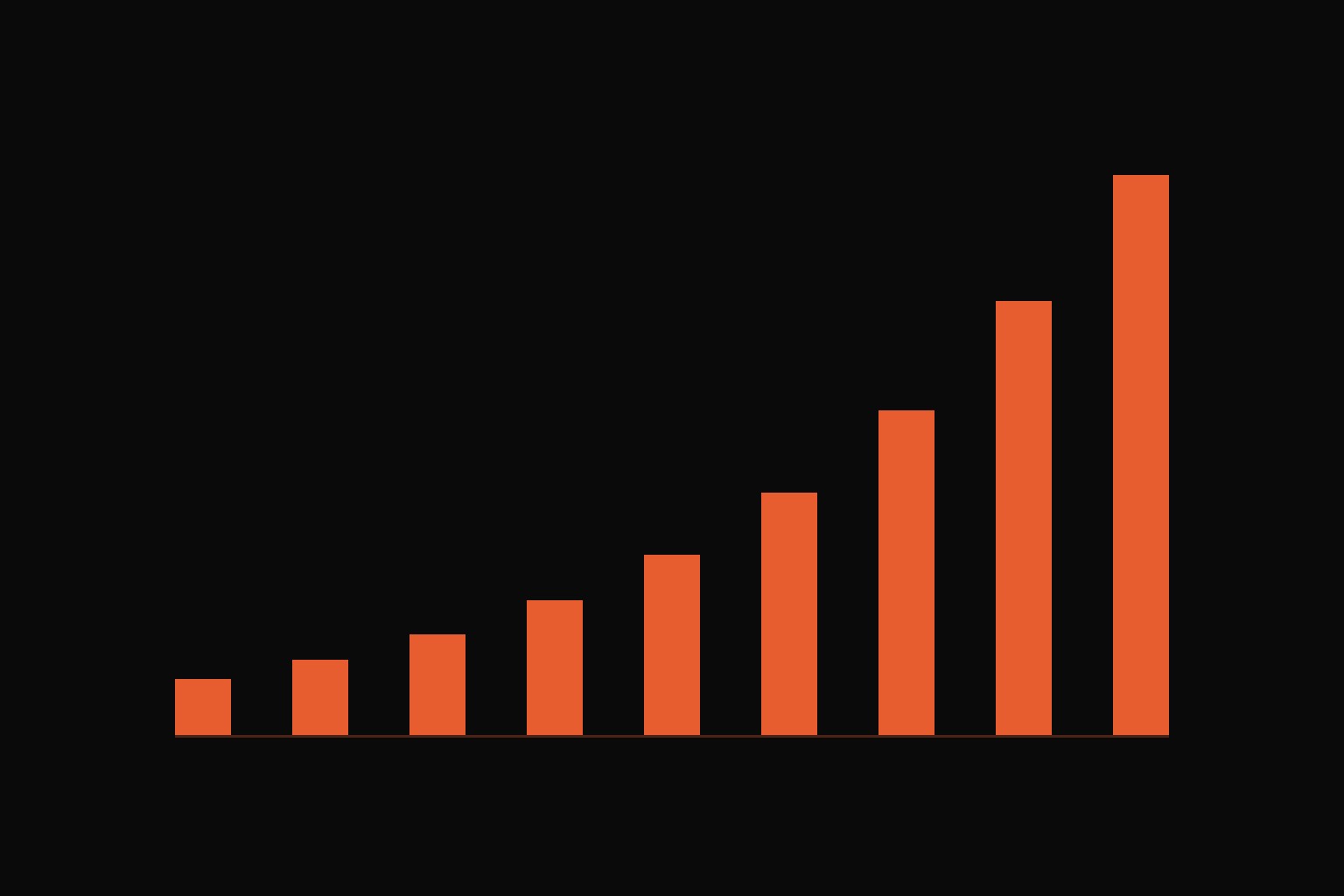
Search rewarded a long tail. Ten blue links left room for the tenth result, and a patient operator could climb the rankings one position at a time. Answer engines do not work that way. When a buyer asks ChatGPT, Gemini, Claude, or Perplexity to recommend a provider, the engine returns a short list, often three to eight names, and the names below that line are not shown at all. The surface is smaller, the competition for it is sharper, and the dynamics that decide who appears are very different from the ones operators spent two decades learning.
The most important of those dynamics is concentration. AI recommendations are not evenly distributed across the qualified field. They cluster around a small set of businesses that the engines have come to treat as safe, well attested answers. And the mechanism that creates that cluster is self reinforcing, which means the advantage of being in it is not static. It compounds.
why AI recommendations concentrate
An answer engine is not ranking pages. It is assembling an answer it can stand behind, and it prefers sources it can corroborate. When a business is described consistently across its own site, third party directories, review platforms, industry coverage, and structured data, the engine sees a coherent entity it can name with confidence. When a business is thinly or inconsistently represented, the engine has less to go on and reaches for a name it trusts more.
This is a reasonable way to build an answer, and it has a predictable consequence. The businesses that are already well represented are the ones most likely to be named. Being named then produces more representation: citations in AI answers get repeated, screenshotted, linked, and absorbed into the next round of training and retrieval. The well attested become better attested. The gap is not noise. It is the system working as designed.
the feedback loop that compounds
Three loops run at once, and each one feeds the next.
The first is retrieval. Engines that browse the live web reward sources that are already linked and cited, so a business that appears in answers accumulates the exact signals that make it more retrievable next time.
The second is training. Today's answers, and the content written about them, become part of tomorrow's model. A business that is consistently named this year is more likely to be embedded in the model's prior next year, before any live search even runs.
The third is behavioral. Buyers act on AI recommendations and then describe them, in reviews, in forums, in their own content. That human residue is more source material confirming the same short list. The recommendation creates the evidence that justifies the recommendation.
None of these loops is dramatic on its own. Together they mean a position in the answer is not a flat benefit you either have or do not. It is a balance that earns interest.
a model of the widening gap
The practical question is how fast the gap opens. The table below is an illustrative model, not a measured dataset, meant to be calibrated with your own category. It tracks two businesses of equal initial quality. The early mover establishes consistent presence in quarter one. The late mover is identical in every respect except that it waits a year. The figure shown is share of recommendations in their category, the percentage of relevant AI answers in which each business is named.
| Quarter | Early mover citation share | Late mover citation share | Gap |
|---|---|---|---|
| Q1 | 12% | 11% | 1 pt |
| Q2 | 19% | 11% | 8 pts |
| Q3 | 28% | 12% | 16 pts |
| Q4 | 37% | 13% | 24 pts |
| Q5 (late mover starts) | 41% | 16% | 25 pts |
| Q6 | 44% | 21% | 23 pts |
Two things are worth sitting with. First, the early mover pulls away even though both businesses are equally good, because presence compounds and absence does not. Second, when the late mover finally begins, it does not snap back to parity. It climbs, but from behind, into a position the early mover has spent a year reinforcing. Closing the gap costs far more than opening it would have.
the cost of waiting
Operators tend to model the cost of acting and forget to model the cost of waiting. In a compounding system the cost of waiting is the larger number, and it is rarely on the spreadsheet.
Waiting has three prices. The first is the share you do not earn while you are absent, which is the visible one. The second is the reinforcement your competitors collect in your absence, which makes their position sturdier precisely because you sat out. The third is the premium you will pay later to dislodge a name the engine has already learned to trust, which is the price almost no one budgets for. A category with a settled, well attested leader is a more expensive category to enter than the same category was when the answer was still unformed.
The window that matters is the one before the answer hardens. Early in a category's AI life, the engines are uncertain, the short list is unstable, and modest, consistent effort moves you onto it. Later, the short list is a habit, and habits are costly to break. The advantage is not only in being early. It is in being early while the answer is still being decided.
what early movers actually do
The businesses that lock in a compounding position are not doing anything mysterious. They are doing the unglamorous things consistently, and they are doing them before the category settles.
They make themselves legible to machines, so an engine can identify the entity and what it does without guessing. They answer the real questions their buyers ask, in plain language a model can lift directly into an answer. They keep their description of themselves consistent everywhere it appears, so corroboration is easy rather than contradictory. And they measure their presence across engines directly, because a position you cannot see is a position you cannot defend.
The discipline is less about volume than about coherence and timing. A business that is clear, consistent, and early will compound. A business that is loud but inconsistent, or careful but late, will not.
what compounding is not
Compounding is an advantage, not a guarantee, and reading it as destiny leads to two mistakes worth naming.
The first mistake is the leader's complacency. A compounding position decays if it is not maintained, because the same loops that built it run in reverse when a business goes stale, contradicts itself across sources, or stops answering the questions buyers have started asking. Engines update, categories drift, and a name that was the safe answer last year becomes the dated one. The interest keeps accruing only while the principal is tended.
The second mistake is the challenger's fatalism, the belief that an established answer cannot be moved. It can, but not by matching the leader head on. Late movers gain by being sharper in a specific pocket, a particular service, a defined region, a buyer segment the generalist leader serves blandly, where the challenger can become the better attested, more specific answer to a narrower question. Concentration cuts both ways. It is hard to dislodge a leader everywhere, and quite possible to out attest them somewhere. The challenger who picks a winnable slice and compounds there builds a position of their own, then widens it.
the strategic read
The shift to answer engines is often framed as a channel change, one more surface to optimize. The compounding dynamic makes it a timing decision. In a winner take most system, the returns to being the trusted answer are nonlinear, and the returns accrue to whoever establishes the position first and holds it consistently. That is a different kind of bet than ranking on page one. It rewards the operator who treats AI presence as a position to take now, while it is cheap, rather than a problem to solve later, once it is expensive.
The math does not require hype to be alarming. Equal businesses do not end up in equal positions when one compounds for a year and the other does not. The only real question is which side of that gap you intend to be on, and how much longer the entry price stays low.
BeFound measures where you stand in AI answers today and helps you take the position while it still compounds in your favor. See your BeFound Score at befound.ai.